
Retatrutide - the strongest weight loss peptide?
Retatrutide is a modern metabolic peptide that is currently dethroning other popular agents of this type, such as tirzepatide or ozempic. Its action is based on the simultaneous influence on several key mechanisms responsible for appetite control, sugar management, and fat burning. As a result, the body reacts faster to satiety signals, utilizes energy better, and reduces unnecessary weight more effectively.
This article was created based on current scientific research, the experiences of individuals using retatrutide, and knowledge in the field of exercise physiology and dietetics. Here you will find specific information about the benefits, real impact on the body, and answers to the most frequently asked questions.
If your goal is a slim figure, better well-being, and appetite control – read on and see what opportunities modern science provides!
What is Retatrutide (GGG)? Understanding the “Triple Agonist”
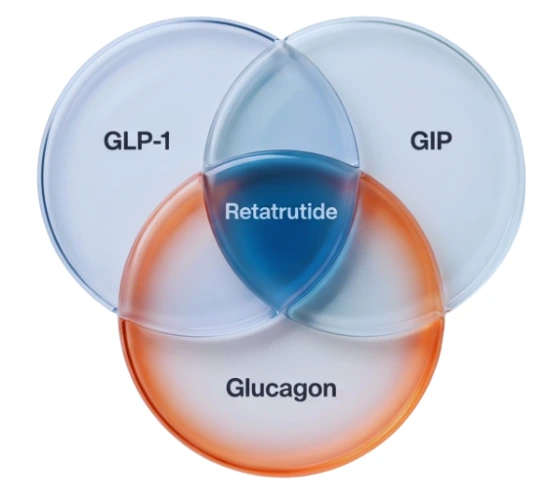
To understand the phenomenon of this weight loss peptide, we must for a moment look under the hood of your metabolism. Until now, the most effective agents acted on one (like semaglutide) or two (like tirzepatide) hormonal pathways. Retatrutide goes a step further – it is a single peptide that mimics the action of as many as three hormones:
- GLP-1 (glucagon-like peptide-1)
- GIP (glucose-dependent insulinotropic polypeptide)
- Glucagon
Imagine your metabolism as a safe with three different locks. Previous peptides had the key to one, sometimes two of them. Retatrutide is a master key that opens all three at once. This is the so-called triple GIP/GLP-1/Glucagon agonist (shortened to GGG).
Thanks to this, the incretin effect (the body's response to a meal) is maximized - but that's not all. The real magic happens where the competition has no entry.
Why is Retatrutide stronger? The secret lies in Glucagon
Here we get to the heart of the matter – something rarely discussed in popular articles. You're probably wondering: “Wait, glucagon raises blood sugar levels! Isn't that dangerous for diabetics?”.
That's a logical question, but in this specific biochemical combination, something paradoxical and fascinating happens. It is the glucagon component that gives retatrutide a crushing advantage over older generations of weight loss peptides.
The mechanism looks like this:
- Semaglutide and Tirzepatide mainly act as a “brake.” They make your stomach empty slower, and the brain receives the “I’m full” signal faster. You eat less, so you lose weight.
- Retatrutide also presses the brake (you eat less), but at the same time… it hits the gas.
The activation of the glucagon receptor (GCGR) in this drug is responsible for increasing energy expenditure and thermogenesis. Simply put: your body starts burning more calories at rest by generating heat. This makes retatrutide attack obesity from two sides at once: it limits calorie intake (you don't feel hunger) and increases their consumption (metabolism speeds up).
It is this thermogenesis that is the missing link allowing one to break through metabolic stagnation.
Retatrutide effectiveness in numbers – NEJM study analysis
Manufacturer promises are one thing, but we are interested in hard data. The results of phase 2 clinical trials, published in the prestigious New England Journal of Medicine (NEJM), caused an earthquake in the world of diabetology.
Let's look at the specifics from the TRIUMPH study:
- -24.2% of body weight – that's how much patients lost on average after 48 weeks on the highest dose (12 mg).
- No “non-responders” – this is extraordinary. In the group taking the highest dose, 100% of participants lost at least 5%. In the case of other drugs, there is always a group of patients for whom the drug simply doesn't work. Here, it worked for everyone.
For context: bariatric surgery offers an average weight loss of about 30-32%. Retatrutide is approaching this result while being a non-invasive method. This is a massive opportunity for people with morbid obesity (BMI > 35) who are afraid of surgery or do not qualify for it for health reasons.
Retatrutide vs Tirzepatide (Mounjaro) vs Semaglutide (Ozempic)
To help you better understand the scale of progress, we will compare the evolution of these weight loss peptides. This shows how quickly this branch of medicine is developing:
- Semaglutide (Ozempic/Wegovy): Acts on 1 receptor. Average weight loss: approx. 15%.
- Tirzepatide (Mounjaro/Zepbound): Acts on 2 receptors. Average weight loss: approx. 21%.
- Retatrutide: Acts on 3 receptors. Average weight loss: approx. 24-26% (studies are ongoing).
Not just weight reduction. Retatrutide regenerates the liver
We focus on the kilograms because that's what's seen in the mirror, but retatrutide may turn out to be a salvation for an organ that suffers in silence – your liver.
Obesity very often goes hand in hand with fatty liver (MASLD, formerly NAFLD). This is a condition that, if left untreated, leads to fibrosis, cirrhosis, and even cancer. Until now, there has been a lack of effective drugs targeted at this ailment. The data presented at the American Diabetes Association (ADA) conference are impressive:
In patients using retatrutide, a reduction in liver fat of over 80% was observed. In many of them, the liver returned to a completely physiological state. Retatrutide literally “detoxifies” the organ responsible for your lipid metabolism. For many patients, this health aspect might even be more important than the aesthetic effect.
Safety profile – Does “stronger” mean “riskier”?
Since the peptide acts triply, are the side effects also triple? Not necessarily, but the safety profile differs slightly from the standards we know. The main adverse symptoms are very similar to those of Ozempic or Mounjaro – they concern the digestive system. You can expect nausea, vomiting, or diarrhea, especially at the beginning of therapy.
However, there is one difference resulting from the presence of glucagon. It can cause a slight acceleration of the heart rate. In clinical trials, an increase in heart rate was observed, which usually stabilized over time. This is precisely why retatrutide dosing is (and will be) very slow and gradual, to give the body time to adapt. Drug tolerance is key to the success of the therapy.
FAQ – Frequently Asked Questions about Retatrutide
What is the difference between Retatrutide and Ozempic?
Ozempic acts only on the GLP-1 receptor (suppresses appetite). Retatrutide is a triple agonist (GLP-1, GIP, Glucagon), which not only suppresses hunger more strongly but also actively accelerates calorie burning through thermogenesis. Thanks to this, it offers a weight reduction about 10% greater compared to semaglutide.
How much weight can you lose on Retatrutide?
In clinical trials published in NEJM, patients lost an average of 24.2% of body weight over 48 weeks of using the highest dose (12 mg). This is a spectacular result, close to the effects of gastric bypass surgery (bariatric), making it the most effective pharmaceutical for obesity currently under study.
Scientific sources
- Jastreboff A.M. et al., „Triple–Hormone-Receptor Agonist Retatrutide for Obesity” — New England Journal of Medicine. A key clinical trial showing the results of retatrutide use in people with obesity (weight reduction, safety profile) — a fundamental scientific article, worth reading in its entirety.
- Review/analysis in Open Access on PubMed Central: „Efficacy and safety of retatrutide…” (2025) — clinical results review and meta-analysis of preliminary studies. An open-access review article summarizing the effects of retatrutide in clinical trials — discussion of body weight changes, metabolic parameters, and the adverse effect profile. Useful if you want to see a synthesis of available data.
- Clinical trial registry — entries regarding retatrutide (e.g., NCT04881760 and subsequent). Details of protocols, inclusion/exclusion criteria, study duration, and results reported to the registry — essential for verifying methodology.